
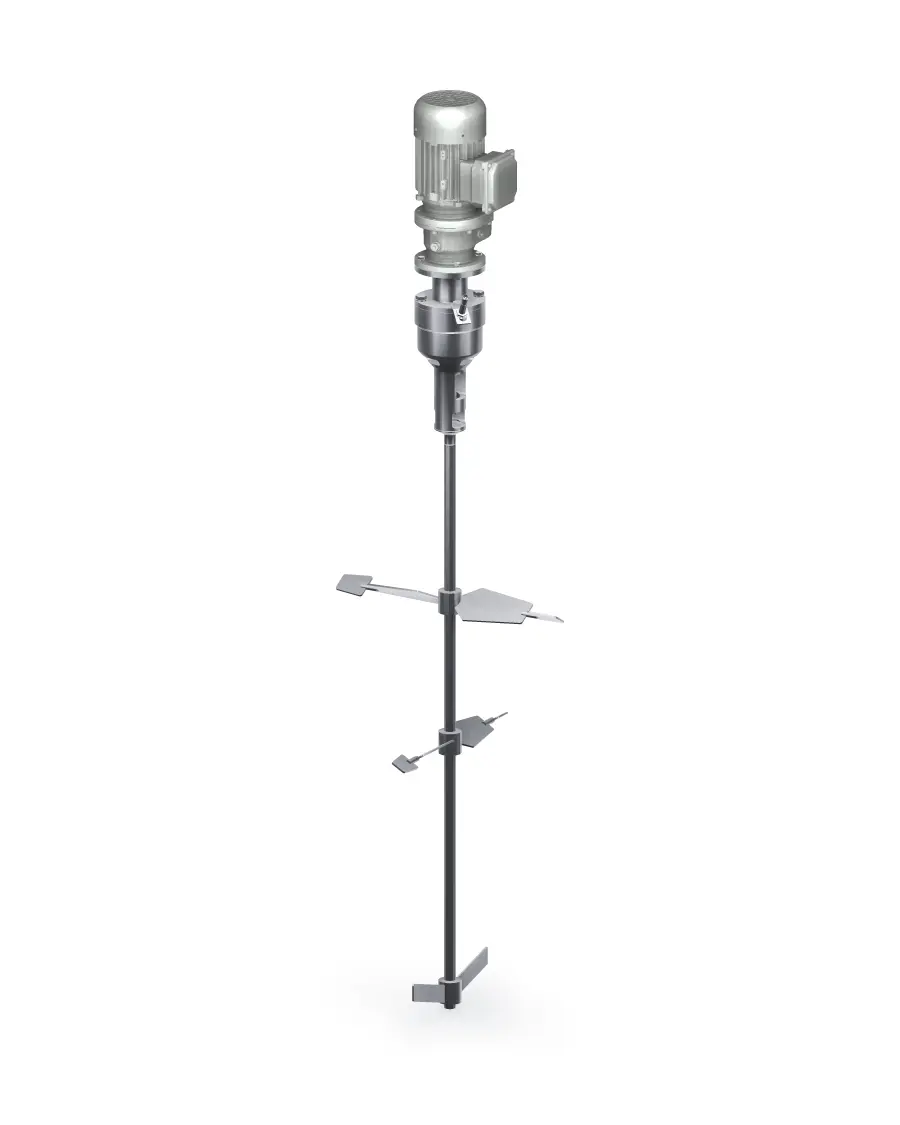
Internal bearingsTMAi
Versatile magnetic agitator for pharmaceutical process vessels. The ceramic bearings allow quiet continuous operation under high hygienic requirements.
For most sterile mixing duties the bottom magnetic agitator is the first choice. Yet not every vessel allows bottom entry. When vessel geometry, bottom piping or process chemistry rule it out, we mount the TMA on the top flange — with the same hermetic magnetic coupling. It is not an alternative to the BMA, but the tool for the cases where the bottom is not an option.
Versions
Both versions transmit torque hermetically through a magnetic coupling and run on ceramic bearings. They differ in where the bearings are located.
Versatile magnetic agitator for pharmaceutical process vessels. The ceramic bearings allow quiet continuous operation under high hygienic requirements.
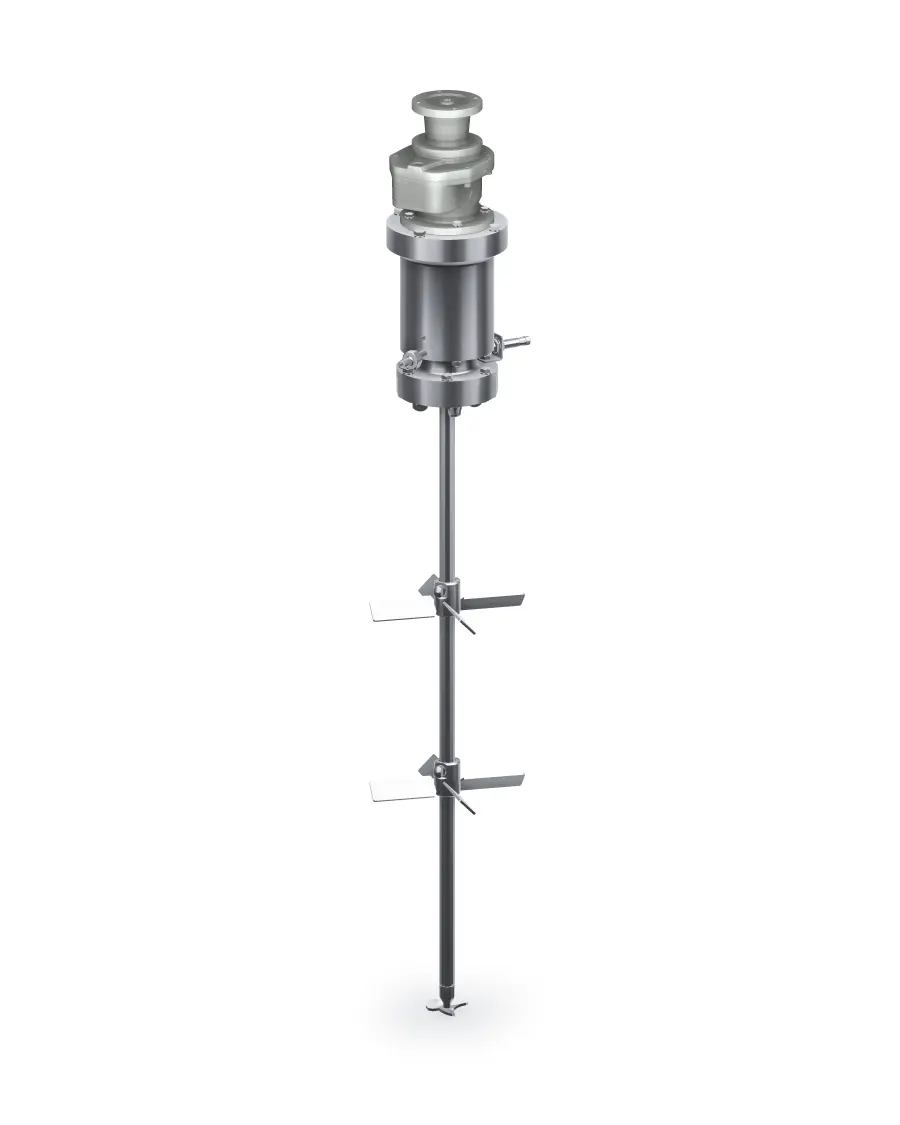
The bearings sit outside the product space. An external CIP/SIP connection keeps the bearing area easy to clean.
Application
A bottom magnet and its weld-in flange take up space on the vessel bottom and can interfere with drain valves or sumps in small vessels. The TMA moves the drive train to the top. The bottom stays free for a central drain and simple harvest piping.
In crystallisation or suspension processes heavy solids settle at the bottom. Starting a bottom agitator while the bearing is buried in sediment wears the ceramic rapidly. With the TMA the bearings sit in the headspace; the suspended impeller lifts the solids off the bottom on start-up.
Many older vessels agitate through a mechanical seal on the top flange. Cutting a hole in the bottom of a certified pressure vessel is usually ruled out for regulatory and financial reasons. We build magnetic drives to the existing DIN or ANSI flange pattern; the vessel's pressure certification is preserved.
A top-mounted shaft without bottom support is subject to deflection and thermal expansion. We calculate critical speed and shaft diameter for every unit. Without a lower bearing support the critical speed limits the shaft length — we design within that limit.
Coupling and interface
The magnetic coupling is sized to viscosity and volume. Every excess kilogram hangs on the top nozzle. The plug-in can is the standard interface.
Impeller
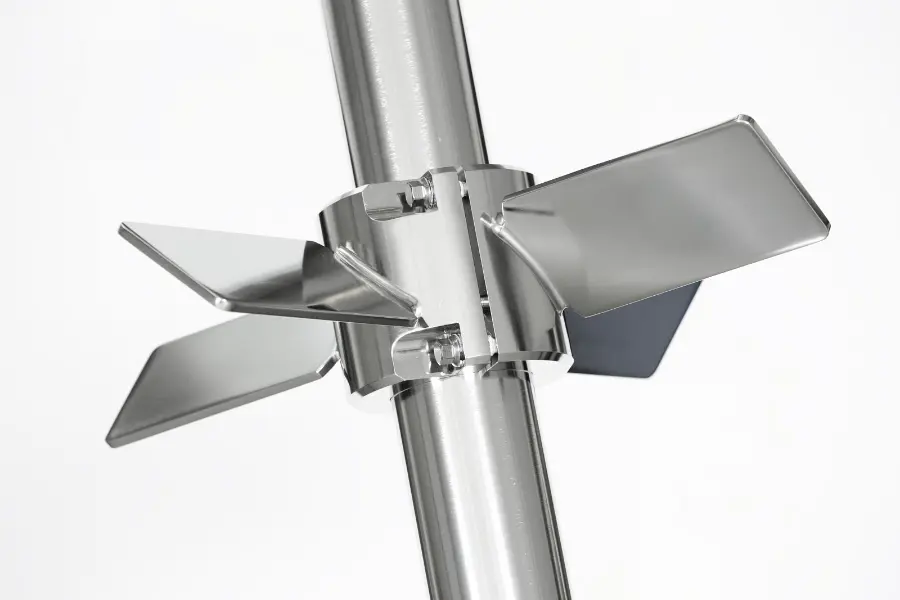
We calculate the impeller diameter from the process data. How it is fixed to the shaft, however, is not a catalogue choice: shaft dimensions and nozzle diameter set the limits.
Drive
With top mounting, the height above the vessel top is often the limit. We define the drive architecture with you according to space and zone.
Contact
Whether and how top mounting works is decided by top flange, nozzle diameter and shaft length. Send us flange standard, nominal size and vessel dimensions.
Prefer to write directly?